A 50-bed residential behavioral health expansion unlocking a state-backed opportunity for restoration, recovery, and long-term community impact.

$19.8M State conditional award
50 New treatment beds
April 1 Match documentation deadline
Presented by Christ-Centered Ministries  |  Capital Campaign  |  March 2026
State award

The moment is now

The State of California has already selected Project RESTORE for a $19.8 million conditional BHCIP award to create 50 new adult residential SUD treatment beds through acquisition and rehabilitation of the Hawthorne site.

$19.8M

Conditional award amount

$1.98M

Required cash + sunk cost match

50

New treatment beds

March 11, 2026

Conditional award notice issued.

April 1, 2026

Match support documentation due.

Mid-April 2026

Sponsor target to begin construction.

October 1, 2027

State completion target in the award notice.

This campaign is not about proving demand. It is about activating the capital required to seize a state-backed window that is already open.
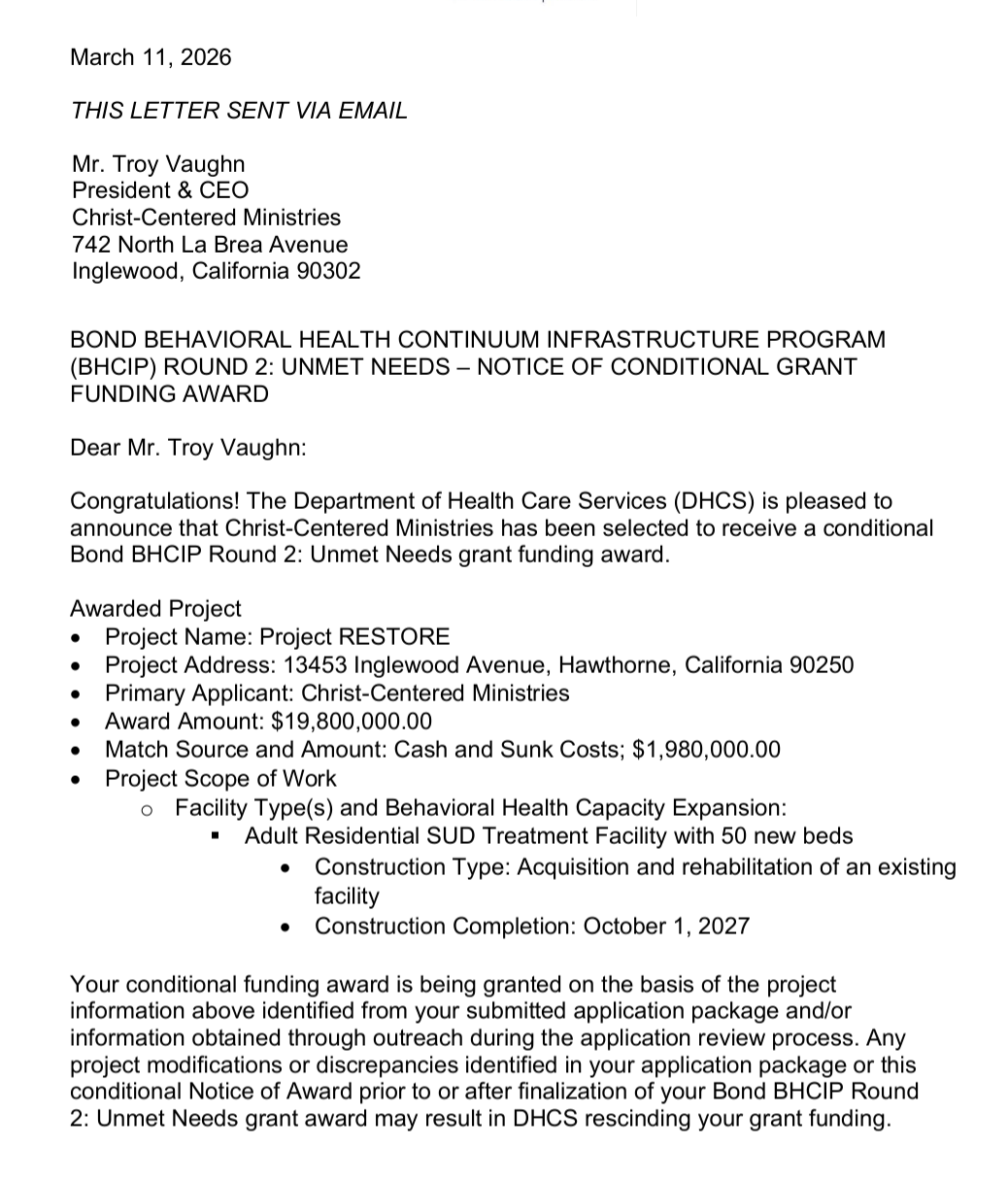
Project RESTORE award letter

Why Los Angeles still needs this project

Need is still measured in people, not abstract percentages.

67,777 People experiencing homelessness in the LA Continuum of Care in 2025.
2,963 Adult residential-level psychiatric bed shortfall estimated in LA County.
50 Beds Project RESTORE adds to the continuum.

Los Angeles County is still confronting both homelessness and a shortage of residential behavioral health capacity. Project RESTORE addresses the infrastructure gap by converting an underutilized property into treatment space that already has public funding lined up.

“Both reports highlight the shortage for subacute and community residential beds for adults.”

Los Angeles County Department of Mental Health bed shortage roadmap
Before / After

Exterior transformation

From an underutilized corner property to a dignified recovery campus.

What changes

Acquisition + full rehabilitation, secured site circulation, upgraded envelope, and a facility designed for behavioral health use.

Why it matters

The physical environment communicates safety, structure, and dignity before a single service is delivered.

Project scope

The state award specifically funds acquisition and rehabilitation of an existing facility.

Current / Future

Resident experience

The campaign is not only about square footage. It is about what healing feels like when a person walks in the room.

Our Current 10 Bed Site

Bedroom

Safe but basic. Function comes first; dignity is limited by the existing environment.

Living space

Shared areas provide shelter, but not always the therapeutic design cues recovery requires.

Kitchen

Residents need spaces that support nutrition, routine, and calm.

New Proposed 50 Bed Site
Future resident rooms and bathroom finishes from the architect’s conceptual rendering package.

Services Provided

CLINICAL ASSESSMENT

TAILORED TREATMENT PLANNING

CASE MANAGEMENT

24/7 MEDICAL SUPERVISION

MEDICATION MANAGEMENT

INDIVIDUAL THERAPY

GROUP & FAMILY THERAPY

12-STEP MEETINGS

WELLNESS ACTIVITIES

AFTERCARE PLANNING

Renderings

Design vision gallery

Three phases

Campaign architecture

This campaign is staged around what the project must fund first, what must be carried during construction, and what it takes to open strong.

Phase 1

Silent / pre-construction

$8.48M target

Raise the required match and acquisition capital by April 1, 2026. This is the major-donor window to secure site control and unlock the state award.

Phase 2

Construction bridge

$6.86M bridge need

Carry contractor draws and construction costs while eligible expenses are submitted for reimbursement under the state award structure.

Phase 3

Program ramp-up

$0.75M sponsor estimate

Cover staffing, licensing, startup supplies, and launch-period cash needs until Medi-Cal billing and operating cash flow stabilize.

Phase 3 amount is a sponsor estimate pending final ramp plan and payer onboarding timing.

How private capital unlocks public dollars

Project RESTORE is a reimbursement-backed capital stack. The opportunity is already funded, but it must be carried.

$15.26M Preliminary development budget
$6.50M Acquisition cost
$6.86M Construction ROM
1
Sponsor cash
0
Verbal commitments
1
Match remaining
4
Requested bank facility
20
State reimbursement
$1:$10
Every $1 of match unlocks $10 of state award capacity.

What donors make possible

  • Close the non-negotiable match required by the state award.
  • Help secure acquisition and preserve schedule certainty.
  • Reduce the amount of expensive bridge capital required during construction.
  • Create launch stability so the program can open with dignity and strength.
Because the award reimburses eligible costs after they are incurred, early private capital does not compete with the public award. It activates it.
Donor levels

Lead with one gift or step in at your level

$1,000,000+
Founding Partner

Anchor the campaign, unlock the state award, and help carry acquisition + pre-construction execution.

$500,000
Vision Builder

Accelerate the silent phase and materially reduce the amount of bridge capital required.

$250,000
Transformation Partner

Fund mission-critical construction and resident-ready spaces with visible impact.

$100,000
Legacy Sponsor

Create durable, named spaces that restore dignity and expand treatment access.

$50,000
Cornerstone Partner

Equip key resident-facing environments and launch essentials.

$25,000
Hope Builder

Support resident startup, furnishings, and opening-period needs.

All levels can be structured as one-time gifts, pledge commitments, or catalytic investments depending on donor preference and campaign phase.

Legacy giving

Naming opportunities

Visible generosity creates durable witness. Naming opportunities can be customized for faith, family, memorial, or institutional recognition.

Opportunity Suggested gift
Facility naming rights$2,500,000+
Residential wing$1,000,000
Courtyard / wellness terrace$500,000
Community living room$250,000
Kitchen + dining commons$250,000
Classroom / study lounge$100,000
Resident bedroom$50,000
Resident startup fund$25,000

Naming menu shown for campaign planning. Final naming rights and recognition agreements remain subject to sponsor approval.

Catalytic capital

How gifts work

This is not a traditional “fund it once and hope” model. The right capital at the right time unlocks reimbursement and positions the program to become revenue-supported.

1.

Donor / partner capital

Match, acquisition, and early bridge support get the project moving.

2.

Project spends

Acquisition closes, construction mobilizes, and eligible costs are incurred.

3.

State reimbursement

Eligible BHCIP costs are submitted and reimbursed under program rules.

4.

Program opens

Staffing, licensure, startup, and admissions ramp toward launch.

5.

Medi-Cal revenue

Billing and operating revenue support the facility over time.

$4.47M-$6.67M

Preliminary annual gross revenue range once stabilized.

Primary paydown

BHCIP reimbursement proceeds during development.

Long-term support

Medi-Cal billing and operating cash flow.

Projected sustainability after launch

The deck is not asking donors to permanently subsidize the operating model. It is asking them to help launch it.

Gross annual income sensitivity ($MM)

4
Conservative
6
Base
7
Stabilized

Operating model assumptions

  • 50 licensed residential beds.
  • Revenue sensitivity shown at 70%, 80%, and 85% occupancy.
  • Illustrative daily revenue range: $350 to $430 per occupied bed day.
  • Final operating performance will depend on licensure, payer mix, contracting, and staffing model.
The capital campaign gets the program to opening day. The operating model is designed to carry it beyond opening day.
Selected project leadership

Executive Leadership Team

A campaign at this level requires visible leadership, operational discipline, clinical readiness, and financial stewardship.

Troy Vaughn
Founder, President & CEO

Co-founded Christ-Centered Ministries in 1999. A survivor of seven years of homelessness on Skid Row, he leads vision, partnerships, and campaign strategy.

Jameese Smith
Chief Operations Officer

Helps drive operational execution and readiness across CCM’s housing and reentry platform.

Chandra Williams
Chief Administration Officer

Provides administrative leadership, cross-functional coordination, and execution support from campaign through launch.

James Phillips
Chief Financial Officer

Provides fiscal stewardship, reporting discipline, and capital planning support for the project.

Karla Solis
Chief Compliance & Healthcare Officer

Leads healthcare compliance, quality, and operational readiness for licensed service delivery.

Anne Carlé
Chief Clinical Officer

Guides the clinical model, treatment design, and service readiness for Project RESTORE.

Credibility

Why this team can carry it

Pastor Troy Vaughn

“From brokenness to purpose” is not a slogan here. It is lived experience at the center of leadership.

Christ-Centered Ministries was co-founded in 1999 and has grown around housing, reentry, recovery support, and community transformation.
CCM’s stated goal is not simply to get people off the streets, but to provide a comprehensive array of supports that lead to lasting stability.
Project RESTORE builds on an existing ministry platform rather than starting from scratch.
“The goal is not simply to get people off the streets, but to provide a comprehensive array of supports that assist people in achieving stability which allows them to move forward with their lives.”

Already doing the work that this project scales

Current care environments and existing ministry infrastructure demonstrate that Project RESTORE is an expansion of capacity, not a speculative concept.

Help us unlock what has already been awarded.

Project RESTORE is ready for capital partners who want their giving to move fast, last long, and change lives.

$1M+ Founding Partner
$500K Vision Builder
$250K Transformation Partner
Contact: Pastor Troy Vaughn  |  Christ-Centered Ministries
(310) 644-4902  |  donate@4ccm.org
Scroll to Top